📖 Introduction & Why This Book Matters
Space is vast, creeping, and paralyzingly lonely—a hostile environment where humanity sits far outside its natural food chain. But what if the cure for that profound isolation is aliens who love science just as much as humans do? Project Hail Mary grounds the terrifying emptiness of the cosmos with deep, emotional human connections. Beneath its hard sci-fi exterior, this is a heartwarming story about the universal power of science and interspecies cooperation. Over and over, Weir's witty, hilarious, and moving story reminds us that you don't have to feel brave to be brave.
✍️ Plot Summary
Ryland Grace wakes up from a medically induced coma on an interstellar spaceship, entirely alone and suffering from severe amnesia. He soon realizes he is locked in a room with the mummified corpses of his two crewmates. As his memory returns in fragmented flashbacks, Grace remembers that Earth is facing an apocalyptic extinction-level threat: a strange, energy-consuming microbe dubbed “Astrophage” is multiplying exponentially and devouring the sun’s output. Without intervention, the resulting drop in solar energy will trigger a rapid ice age, mass global starvation, and the end of humanity.
To combat this, Earth’s governments united under the ruthless, uncompromising leadership of Eva Stratt to launch the Hail Mary, a desperate suicide mission known as humanity’s last hope. The mission’s destination is Tau Ceti, the only local star mysteriously immune to the Astrophage infection. Grace, a disgraced molecular biologist turned beloved junior high science teacher, was drafted for the mission because he possesses a rare genetic sequence granting him resistance to the deadly comas required for the interstellar journey. His objective is to discover Tau Ceti’s secret to resisting Astrophage and send the data back to Earth on small, automated probes named after the Beatles.
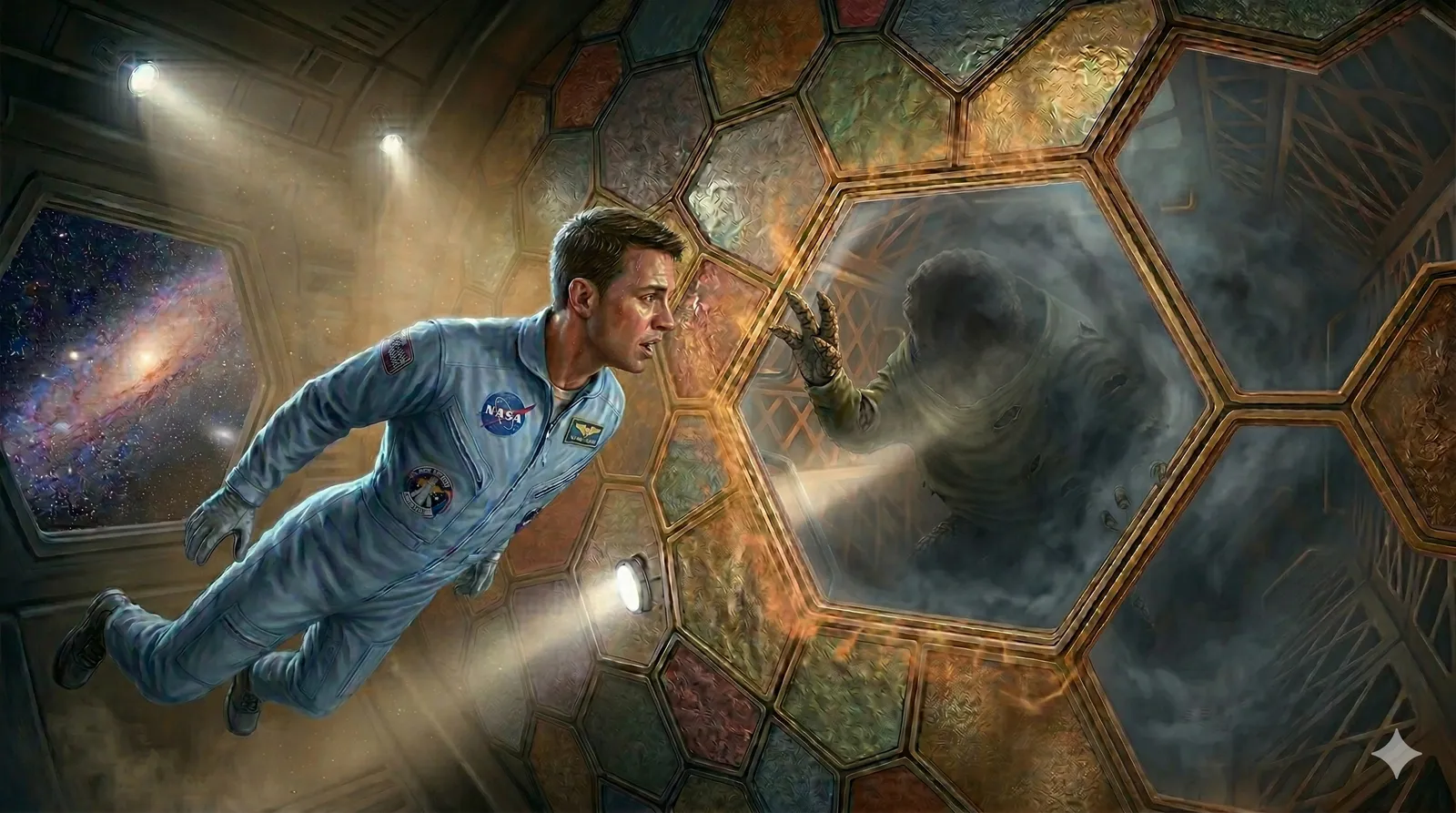
Upon arriving at Tau Ceti, Grace makes the most monumental discovery in human history: another alien spacecraft. He meets “Rocky,” a brilliant, pragmatic, five-armed alien engineer whose body is composed of inorganic silicates and liquid mercury. Rocky hails from the planet Erid, and his species is facing the exact same Astrophage crisis. Like Grace, Rocky is the sole survivor of his crew.
Separated by biology, a toxic atmosphere, and language, the two isolated astronauts forge a profound interspecies brotherhood. They communicate through the universal language of math and science, build a dividing wall to share a workspace, and team up to unravel the Astrophage mystery. Together, they locate Adrian, a planet in the Tau Ceti system that harbors a natural predator to Astrophage called “Taumoeba.” However, extracting and breeding this predatory microbe brings a cascade of catastrophic biological and mechanical challenges. Grace and Rocky must risk their lives, combining human science and Eridian engineering, to secure the cure and save both their dying worlds.
💡 Key Takeaways & Insights
The Universal Language is Science: Grace and Rocky overcome immense biological and linguistic barriers by using basic scientific principles—like math, mass, and the speed of light—to communicate and build trust.
True Bravery is Overcoming Fear: Grace is not a stereotypical, fearless astronaut; he is naturally risk-averse. His journey demonstrates that heroism isn’t the absence of fear, but acting for the greater good despite it.
Morality in the Face of Extinction: The character of Eva Stratt embodies ruthless pragmatism, demonstrating the terrifying and uncompromising authority required to save a dying species, even if it means sacrificing individuals or bending global laws.
🤯 The Most Interesting or Unexpected Part
The narrative masterfully subverts the “heroic sacrifice” trope through a shocking flashback. Throughout the story, the reader assumes Grace bravely volunteered for this suicide mission to save his students. However, it is eventually revealed that he actually refused out of sheer terror and was forcibly conscripted, drugged, and placed on the ship against his will by Eva Stratt. This twist completely recontextualizes his character, turning him from a flawless savior into a flawed, relatable human who must earn his heroism in the present.
🏛️ How This Book Applies to Real Life
Global Cooperation and Crisis: The international response to the Astrophage threat mirrors real-world global crises like climate change or pandemics. Nations are forced to put aside geopolitical boundaries, share resources, and pool scientific knowledge under the Petrova Taskforce to solve a shared existential threat.
The Importance of Education: Grace’s core motivation stems from his love for his junior high science students. His character highlights how educators shape the future and bear the heavy emotional weight of the world the next generation will inherit.
Who should read Project Hail Mary?
If you liked the intense, science-driven survival scenarios in The Martian or the hard sci-fi world-building in Seveneves, then you will love the brilliant engineering and MacGyver-style problem-solving throughout Project Hail Mary.
Readers who appreciate character-driven sci-fi and deeply emotional interspecies friendships.
Anyone who loves a relentless, tight pace balanced with approachable humor and puzzle-box tension.
📚 Final Rating
4.7 / 5 stars
The novel masterfully balances hard science and existential dread with a heartwarming, funny, and deeply relatable human-alien friendship. The relentless pacing and natural voice make it a standout in the sci-fi genre.
🎯 Should you read it? Yes. Even if you typically dislike space settings, the frequent flashbacks to Earth and the profound emotional connection between the characters alleviate the isolating dread usually found in “lone voyager” narratives.
🔥 Final Thought Project Hail Mary proves that even in the darkest, most terrifying voids of the universe, hope, humor, and a really good science experiment can save the day.
Discussion Topics
- The Morality of Eva Stratt Eva Stratt is given absolute legal immunity to stop the Astrophage threat. She uses this power to conscript Grace against his will, draft a convicted embezzler out of prison, and order the nuclear bombing of Antarctica to release greenhouse gases.
Discussion Questions: Do the ends justify the means when the survival of the human race is at stake? Was Stratt right to force Grace onto the ship against his will, knowing he was the only qualified person who could survive the coma? How does Stratt’s approach to leadership differ from Commander Yáo’s?
- Interspecies Friendship and Communication Ryland and Rocky are entirely alien to each other, with different biologies, atmospheres, and senses. Yet, they form a bond built on trust, shared trauma, and mutual scientific curiosity, to the point where Rocky asks Grace to watch him sleep for protection.
Discussion Questions: How does the author use science and math as a bridge to build the relationship between Grace and Rocky? Why do you think Grace and Rocky’s friendship feels so relatable and human, despite Rocky and Grace being aliens to one another? How does Rocky’s presence change the tone of the typical “lost in space” survival narrative?
- Bravery vs. Cowardice Grace initially views himself as a coward, having abandoned his academic career after a poorly received paper and refusing to go on the Hail Mary mission out of fear.
Discussion Questions: How does Grace’s realization that he was forced onto the ship change your perception of his character? In what ways does Grace prove his bravery in the present timeline, despite his past cowardice? Does Grace’s ultimate decision to save Erid instead of returning to Earth complete his character arc?
Discussion
Comments are moderated and will appear after review by the site owner.
No comments yet. Be the first to share your thoughts!